Yes, when it's nutritionally complete. Ingredients make up most of a dog food's footprint, and plant proteins need far less land, water, and energy than animal proteins. A 2025 study of dry dog foods found plant-based recipes produced more than ten times lower emissions than beef-based recipes. Our own life cycle assessments found over 80% lower emissions than conventional kibble.


At Petaluma, we are reimagining pet food to be out-of-this-world sustainable without sacrificing nutrition and quality. Do better for the Earth while doing the best for your pup.
80%+
Lower greenhouse gas emissions
60%+
Less freshwater
~90%
Less land
Results are from independent life cycle assessments against conventional kibble.
Measure your pawprint
See how much switching to Petaluma could shrink your dog's environmental footprint in a year.
Annual resource savings vs. traditional dog food
lb CO₂e · greenhouse gas
gallons of freshwater

acres of farmland
What's inside the bag counts most
When researchers measure a dog food's footprint from farm to front door, most of it comes from the ingredients. A 2024 life cycle assessment of a dry dog food found that at least 70% of its environmental impact came from the raw ingredients, and shipping it to customers accounted for less than 1%.¹
That's why we focus on our ingredient supply chain above all else.
Plant proteins like chickpeas, peas, and oats need a small fraction of the land, water, and emissions that animal protein does.
Measured, not estimated
We conducted life cycle assessments (LCAs) to quantify the land, water, energy, and emissions behind each formula, from growing the ingredients to baking, packing, and shipping. Measuring every step gives a true picture of a food's footprint.
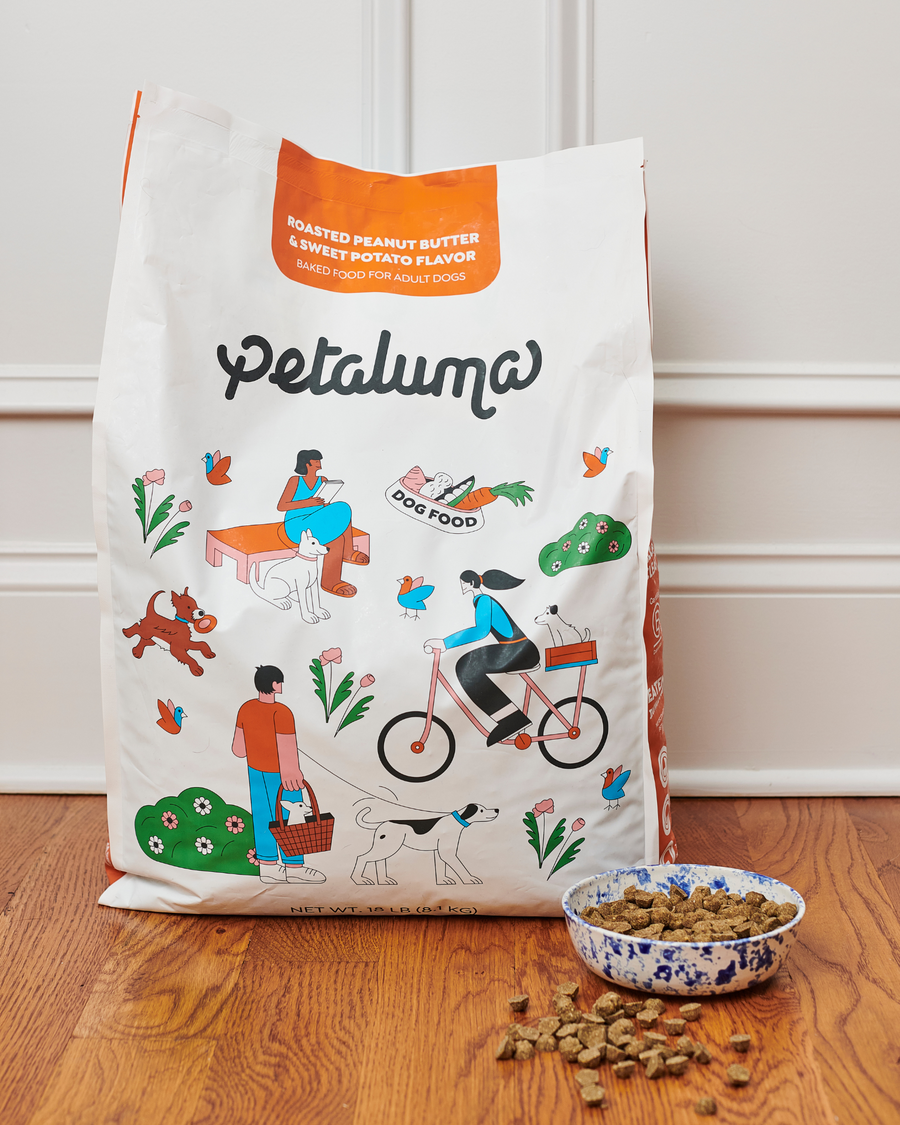
Roasted Peanut Butter & Sweet Potato
83%
lower greenhouse gas
62%
less water
88%
less land
Our adult recipe was assessed in January 2022. The full report opens as a PDF, and no email is required.
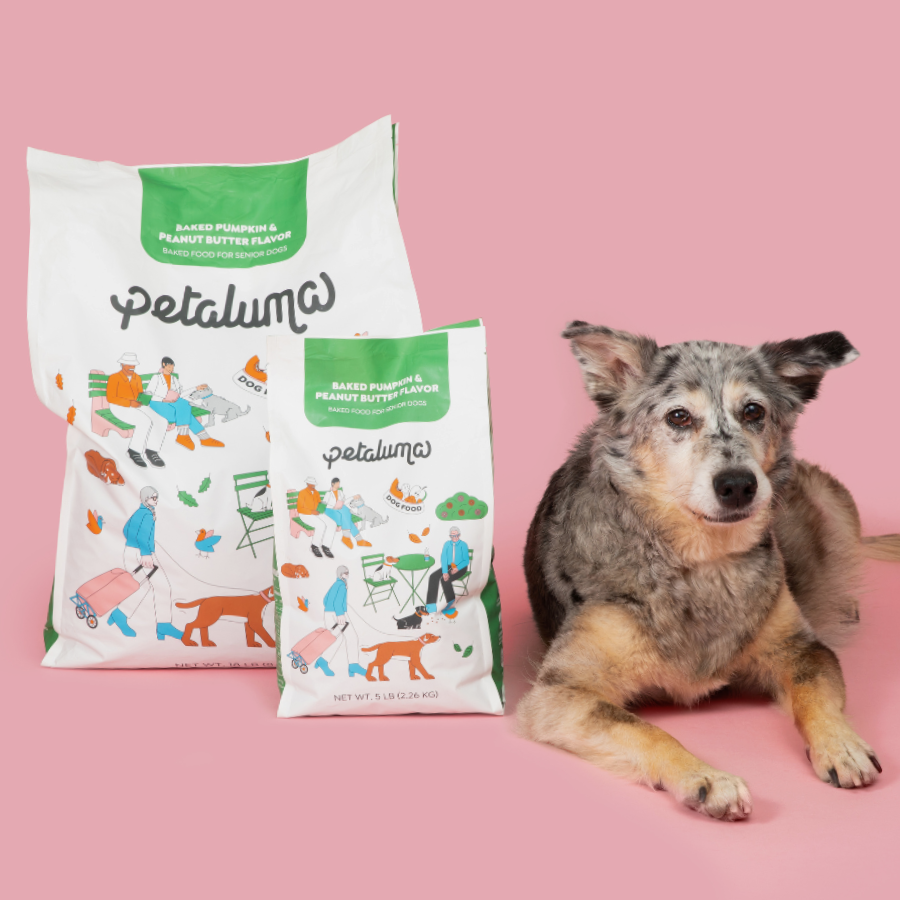
Baked Pumpkin & Peanut Butter
84%
lower greenhouse gas
68%
less water
89%
less land
Our senior recipe was assessed in 2023. The full report opens as a PDF, and no email is required.
Where your bag goes next
Packaging is a small share of Petaluma's overall footprint, but it's an area where we keep testing new materials. Our heavier food bags are the hardest part, because compostable materials aren't yet strong enough to reliably survive packing and shipping a full bag of food. (Unfortunately, we learned that lesson the hard way!)
*Our multi-layer bags are accepted at plastic bag drop-off bins in some pet stores and by TerraCycle through the mail.
The science of a smaller pawprint
In the U.S., feeding dogs and cats accounts for 25–30% of the environmental impact of animal agriculture, so what goes in the bowl really adds up.⁴

Plant-based protein

Baked with solar power

Organic farms

Renewable packaging
Recent coverage of pet food & climate
Forbes
Your Pup's Dinner Can Have Greater Climate Impacts Than Your Own Meals
Jan 2026
Read the articleAssociated Press
Pets contribute to greenhouse gases like us. Here's how to reduce their carbon pawprint
Nov 2025
Read the articleAnthropocene Magazine
Researchers compare the footprint of meat vs. plant-based dog foods
Oct 2025
Read the articleTIME
The Most Climate-Friendly Pet Food, According to Science
Nov 2022
Read the article
Sustainability is baked into our company

Certified B Corporation
As a Certified B Corporation, Petaluma is independently audited on its social and environmental impact across the whole company. We were among the first pet food brands to earn certification in 2022 and was named Best for the World for environmental impact that same year.

The Climate Label
In 2021, Petaluma became the first pet food company to earn Change Climate certification. Every year, we do the detailed work of measuring the emissions from making our food and delivering it to your door, so the impact of every bag stays transparent.

1% for the Planet
Petaluma is a member of 1% for the Planet, a global network of businesses that give 1% of annual sales to environmental nonprofits. We go beyond that pledge, focusing on farmworkers and food insecurity through groups like the Alameda County Community Food Bank.
Common questions
Is plant-based dog food better for the environment?
How do you measure Petaluma's footprint?
We commissioned an independent life cycle assessment for each baked recipe, covering everything from growing the ingredients to shipping the finished bag. Both full reports are public, and you can download them from this page.
Is Petaluma's packaging recyclable or compostable?
Our jerky bag is certified home compostable, and our shipping boxes and inserts are recyclable at the curb. Our food bags need several layers to stay fresh, so they go in the trash for now, although some pet stores and TerraCycle collect them.
What does The Climate Label mean?
It means we measure the emissions from making and delivering our food every year, apply a fee to every tonne, and use that budget to fund projects that reduce emissions. We also report our emissions and our reduction plans publicly. The Change Climate Project, the nonprofit formerly called Climate Neutral, evaluates our progress each year. Petaluma was the first pet nutrition company to earn the certification, in 2021.
Does a smaller footprint mean less nutrition?
No. Our recipes are formulated by veterinary nutritionists to meet AAFCO standards, and we publish the lab results for every formula.

Try Petaluma Today
Join our pack of sustainable pups
- Costa JL, et al. Life cycle assessment of the production of an extruded dog food in Brazil. Journal of Cleaner Production. 2024;458:142505.
- Nicholles B, Knight A. The environmental sustainability of meat-based versus vegan pet food. Frontiers in Sustainable Food Systems. 2025;9:1569372.
- Tuck SL, et al. Land-use intensity and the effects of organic farming on biodiversity: a hierarchical meta-analysis. Journal of Applied Ecology. 2014.
- Okin GS. Environmental impacts of food consumption by dogs and cats. PLOS ONE. 2017;12(8):e0181301.
- Brociek RA, Gardner DS. Environmental impact of feeding plant-based vs. meat-based dry dog foods in the United Kingdom. Frontiers in Sustainable Food Systems. 2025;9:1633312.
- Alexander P, et al. The global environmental paw print of pet food. Global Environmental Change. 2020;65:102153.
- Pedrinelli V, et al. Environmental impact of diets for dogs and cats. Scientific Reports. 2022;12:18510.